
Cobb County Criminal Court Cases
Cobb County divides criminal work by court and charge. Superior Court has exclusive jury-trial jurisdiction over felonies and concurrent power over misdemeanors. Its clerk maintains indictments, accusations, motions, judgments, and sentences. State Court hears misdemeanors and traffic matters in a separate docket system. Magistrate Court handles warrants, first appearances, and preliminary matters before a prosecutor files a trial-court case.
Municipal courts keep city ordinance and many traffic files. A Marietta or Smyrna municipal disposition is not certified by Cobb State Court merely because the city sits in Cobb County. Start with the charge level and arresting jurisdiction. The court name on a citation, warrant, calendar, or prior notice is often the best clue.
Which Cobb Court Has It?
The downtown court core and the jail campus are separate. That physical split mirrors the records. Felony case documents go to the Clerk of Superior Court at 32 Waddell Street, Marietta, Georgia 30090, 770-528-1300. State Court Administration can be reached at 770-528-2622, while the State Court Clerk uses 770-528-2660 and statecourt@cobbcounty.gov.
The official Cobb court overview helps distinguish court roles. A sheriff booking charge is not a filed accusation. Likewise, a magistrate warrant number may exist before a State or Superior case number. Match the identifier to the office that created it.
Municipal jurisdiction is another frequent source of false negatives. A city ordinance or fine-only traffic matter can stay in the city court and never enter the State Court criminal search. Conversely, a state-law misdemeanor can move to Cobb State Court, while a felony belongs in Superior Court. Check the badge or agency number, citation heading, and charge level before choosing a clerk.
The Superior Court services page shows the felony-level court context.
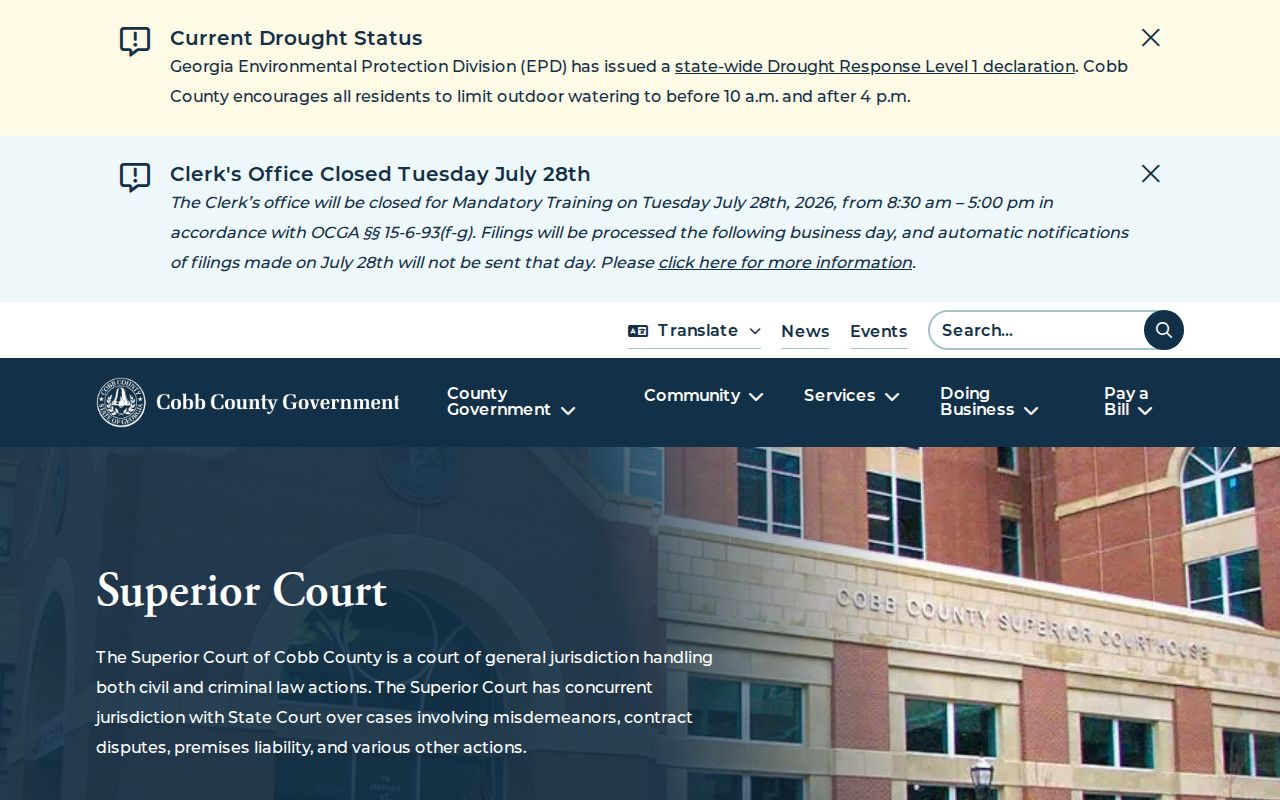
This view helps route a felony file to the proper Cobb County clerk.
Searching Cobb County Case Records
The free Cobb State Court Records Search is the detailed online route for misdemeanor and traffic-related criminal cases. It returns no more than 5,000 records, so a broad common-name query can be incomplete. Use the case number when known. Otherwise, combine name, birth year, and a sound filing range.
- Select Criminal Cases in the State Court search.
- Enter a case number or a well-matched name. Use phonetic search only for uncertain first or last name spelling.
- Add birth year or filing dates to narrow the result set.
- Complete reCAPTCHA, submit, and open the likely docket. Compare court, file date, status, and charge labels.
- Ask the correct clerk for a copy or certified judgment when the online index is not enough.
| Field | Type | Required | Use |
|---|---|---|---|
| Criminal Cases | Radio | Yes | Selects the criminal index |
| Last and First Name | Text | No | Phonetic option applies to these fields |
| Birth Year | Four digits | No | Criminal searches only |
| Filing Start and End | Dates | No | Narrows common names |
| Case Number | Text | No | Pattern shown as 24-A-12345 |
| Citation or Tag | Text | No | Special school-bus case fields |
| Security Verification | reCAPTCHA | Yes | Required before Submit |
The official search interface shows the fields described above.
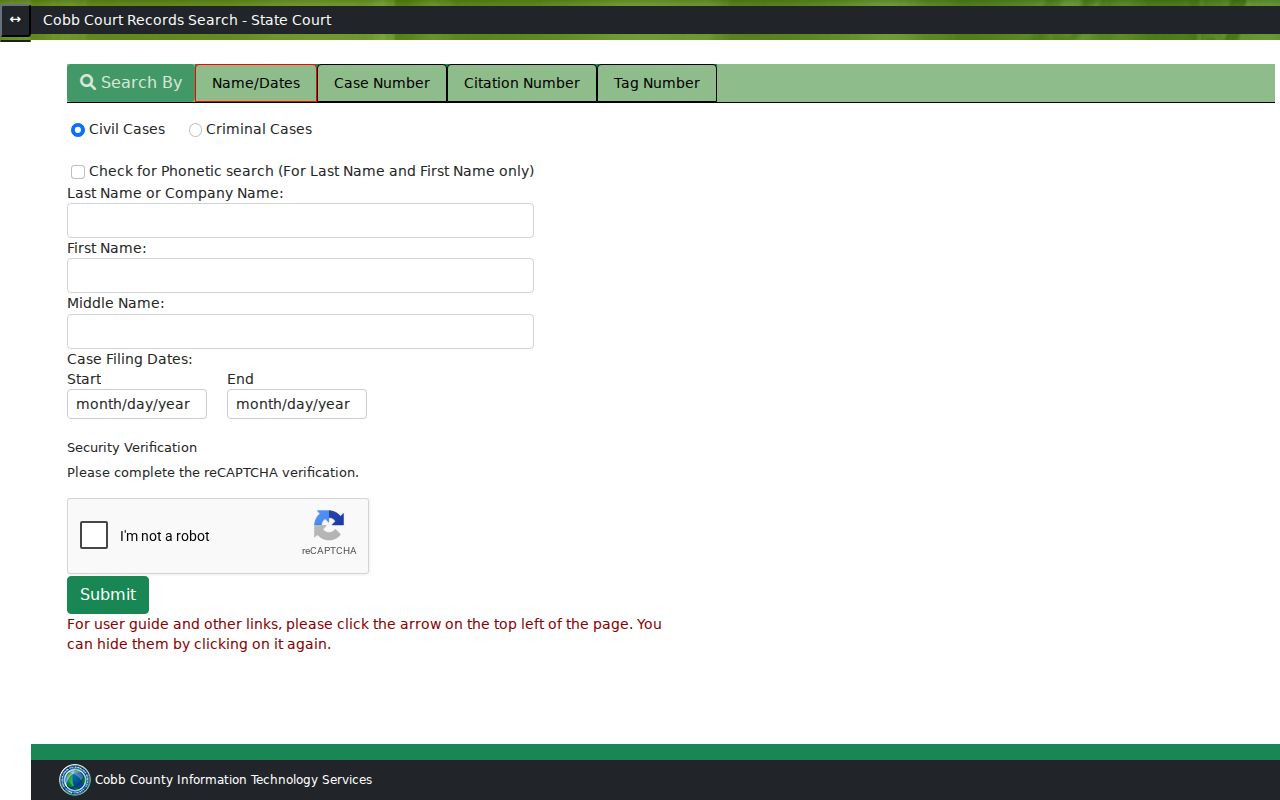
Search controls are for focused individual queries, not direct bulk query URLs.
School-bus citation and tag fields are specialized. They should not be treated as general traffic-ticket fields. When a case number is known, the displayed YY-A-NNNNN pattern is the narrowest route. Save the resulting court name and number before moving to document requests.
Cobb Case Search Traps
Phonetic matching can help with a spelling error, but it can also widen the result set. Filing dates can separate repeat names, yet a guessed range may hide the right case. A no-hit result does not prove that no Cobb County criminal court case exists. The file may sit in Superior Court, a municipal court, an older archive, or a stage that has not received a trial-court number.
The State Court Connect page gives the official access context for this separate Cobb County system.
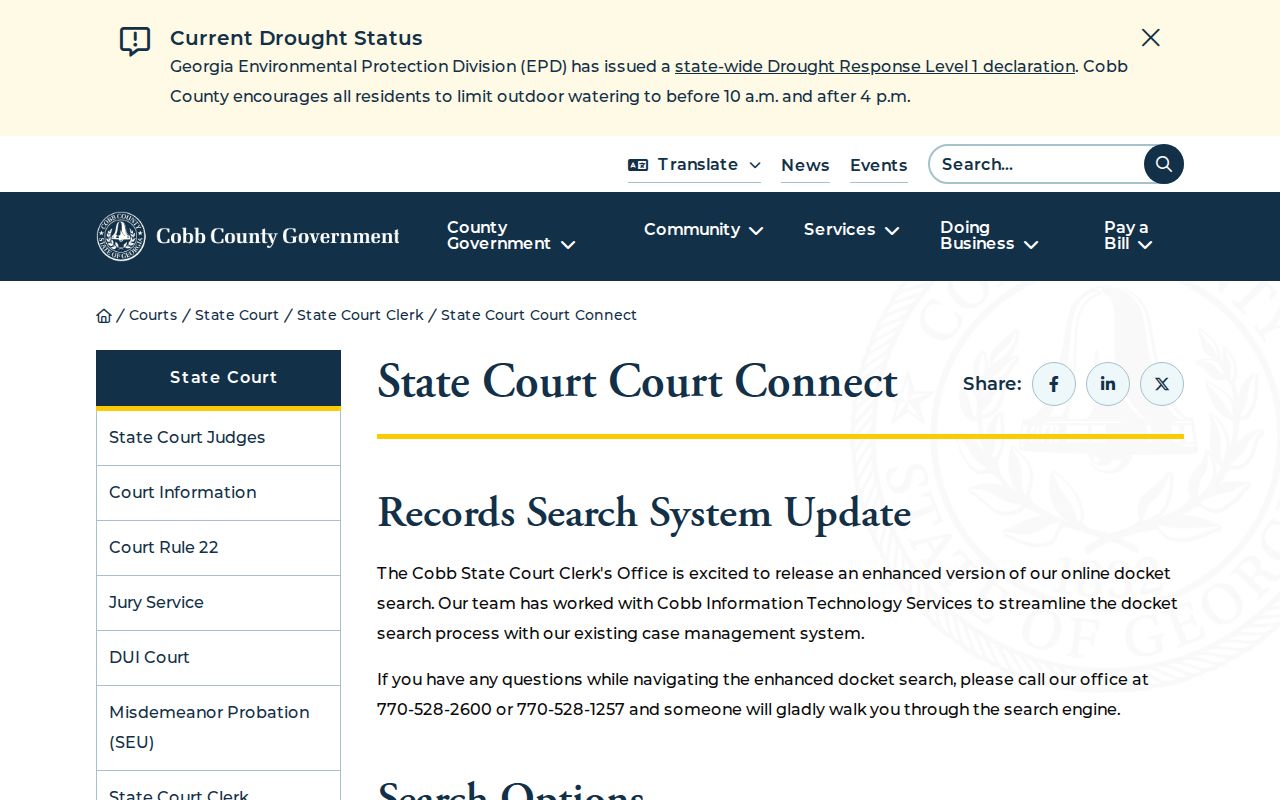
When the index fails, contact the clerk with the most exact name, date, and case identifier available.
Inside a Cobb County Case File
A docket is a record of filed events, not a one-line verdict. Preserve the court name, case number, defendant display, filing date, status, and exact charge and event labels. Then decide whether information from the index is enough or whether a certified disposition is needed.
| Header | Case number, court, filing date, status, and case type |
|---|---|
| Parties | State of Georgia, defendant, and attorneys when entered |
| Charges | Description, count, felony or misdemeanor marker, and sometimes statute |
| Events | Arraignment, motions, hearings, plea or trial, disposition, and sentence |
| Calendar | Hearing date, time, judge, courtroom, and location when shown |
| Financial | Fines, fees, adjustments, and balances where exposed |
| Documents | Online availability varies; certified records come from the clerk |
| Cross-reference | Citation, police, warrant, or companion case numbers may appear |
Note: A zero financial balance does not prove dismissal, acquittal, or any other specific Cobb County case outcome.
Certified Cobb Criminal Documents
For proof of a felony outcome, use the Superior Court Clerk request-copies channel. Give the exact case number and ask for the indictment or accusation, final disposition or judgment, sentence, and any publicly accessible sealing or restriction order. Exact identifiers reduce the chance of a wrong-person file and may reduce research work.
The official copy channel illustrates the difference between browsing and obtaining an authenticated court product.
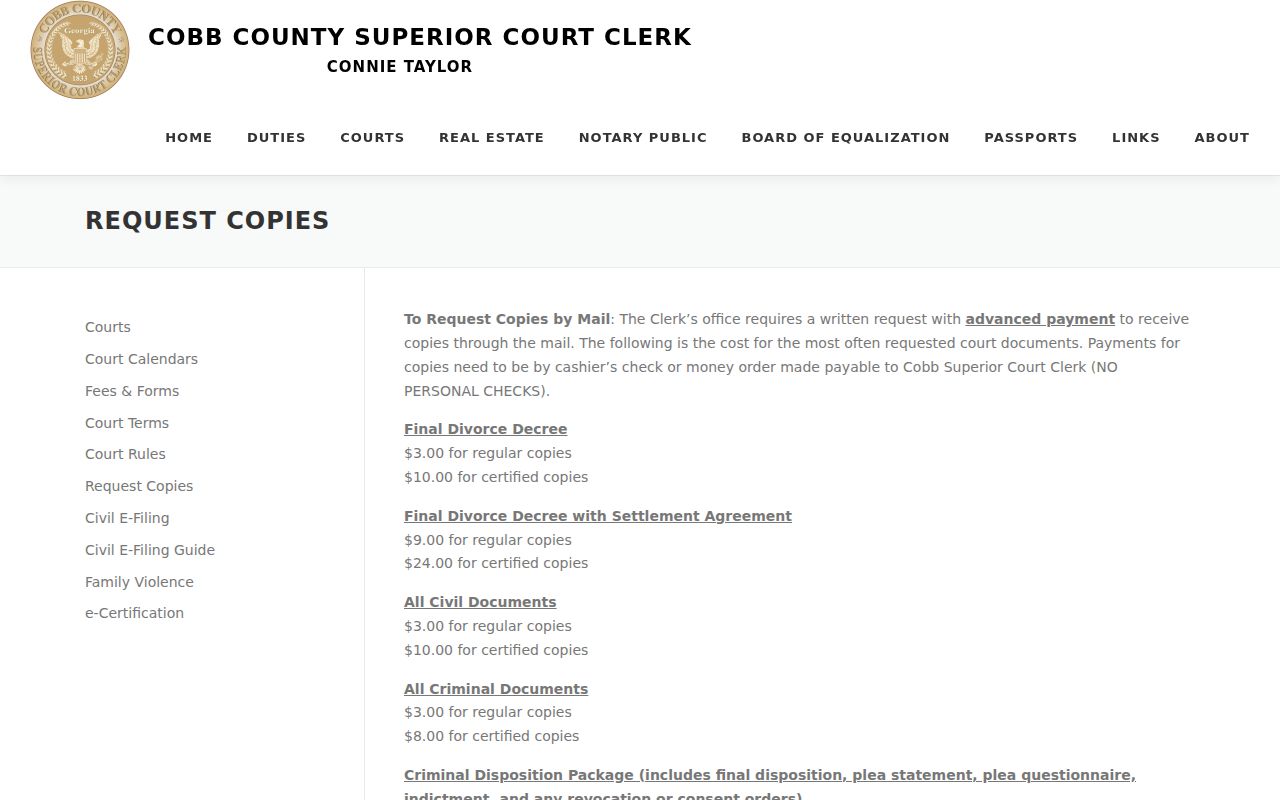
State Court records should go through its clerk, while a city court must certify its own municipal disposition.
How a Criminal Case Moves
A Cobb County arrest may first produce a jail entry and magistrate identifier. Prosecutors then decide which counts to file. The charging document controls the court case, and it may differ from the allegation shown at booking. Pretrial motions and hearings follow arraignment. A plea or trial leads to disposition, then sentencing when required.
Case flow: Charges Filed › Arraignment › Pretrial › Plea or Trial › Disposition › Sentencing
Court calendars are time-sensitive snapshots. They may confirm a scheduled hearing, judge, and location, but they do not prove the final result.
Reading Cobb Case Outcomes
An open, closed, disposed, or inactive status is not the disposition itself. Read the final judgment. A sentence event should also be checked against the filed sentencing document. Charge labels may change from arrest to accusation, indictment, plea, or judgment, so quote each stage with its source.
- Arraignment
- The hearing where the filed charge is presented and a plea is entered.
- Disposition
- The legal outcome of a count, such as conviction, dismissal, or acquittal.
- Judgment
- The court document that records the formal outcome.
- Docket
- The ordered index of filings, hearings, and court events.
Readers tracing an arrest into a filed case can use the separate Cobb County arrest lookup for custody-source context.
Older Cobb Court Files
When an older or non-digitized Cobb County criminal court case is absent online, contact the clerk rather than expanding a web search indefinitely. Supply the full name used in court, approximate filing year, charge type, and any citation, warrant, police, or companion case number. Ask whether an index entry, paper file, or archived certified disposition exists.
For a formal public-record request, Georgia law generally requires a response within three business days that produces records or states when they will be available and estimates cost. The agency need not create a new summary. Court-file access also remains subject to court rules and confidentiality law.
Inspection and electronic production can be requested when available. The first quarter-hour of agency search, retrieval, and redaction time is generally not charged under O.C.G.A. §50-18-71, but no current Cobb clerk fee schedule was confirmed in the research. Ask for an estimate instead of assuming a copy or certification price.
Case Record Access & Restrictions
The Georgia Open Records Act policy favors access, but public access does not mean every field appears online. Juvenile matters, sealed or restricted records, victim information, medical material, and some active-investigation content can be withheld or redacted. State Court exposes birth year rather than a full date of birth.
Ask the custodian to identify the legal basis for withheld material and release segregable portions when possible. If a Cobb County criminal case does not appear, check the correct court and request clerk help before treating the absence as a final answer. An online index serves discovery and navigation. A clerk-certified judgment remains the stronger proof of outcome.
Older or non-digitized material may require a direct clerk request even when the public search returns nothing. Give the exact case number when available and identify the document needed, such as the accusation, indictment, final judgment, sentence, or a public restriction order. This keeps the Cobb County search focused and reduces the chance of receiving a different person's file.